For clinicians
Cardio‑metabolic context between visits.
Blood sugar patterns and blood pressure from one optical sensor at the wrist, day and night. No needle, no patch, no cuff.
What your patient’s app shows, how it performed against reference devices, how it measures, and how to work with us.
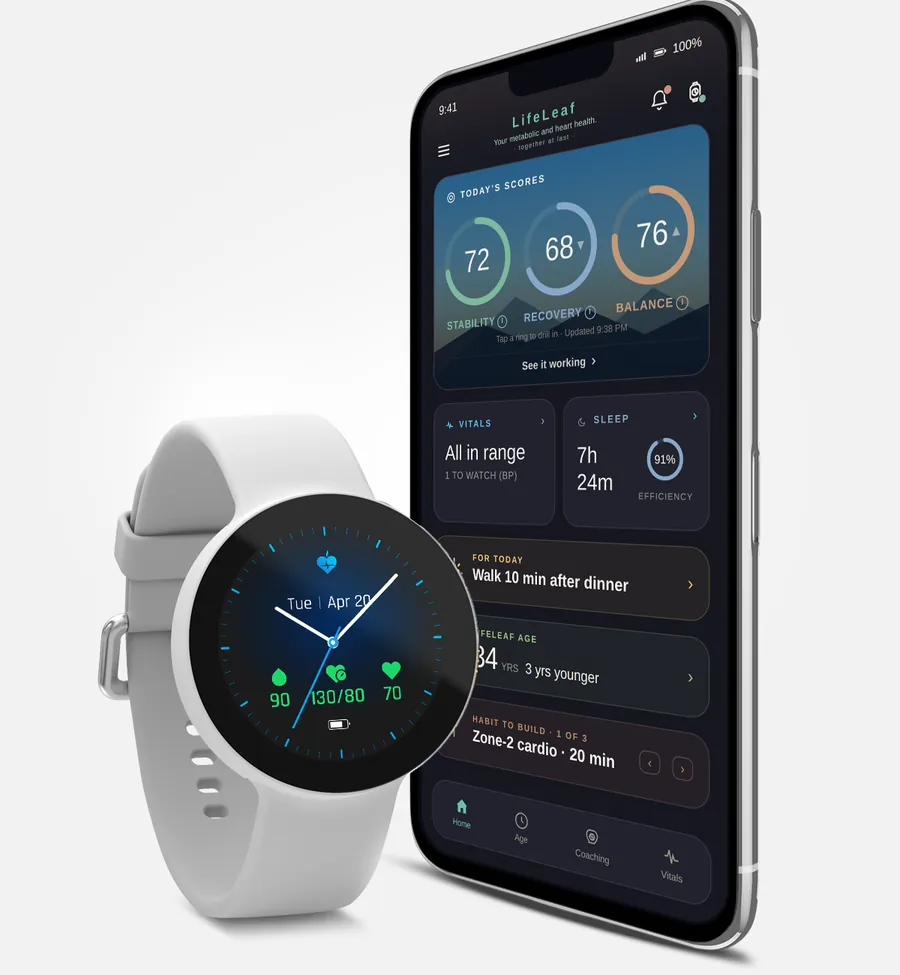
What your patient brings you
Patterns you can read in a minute.
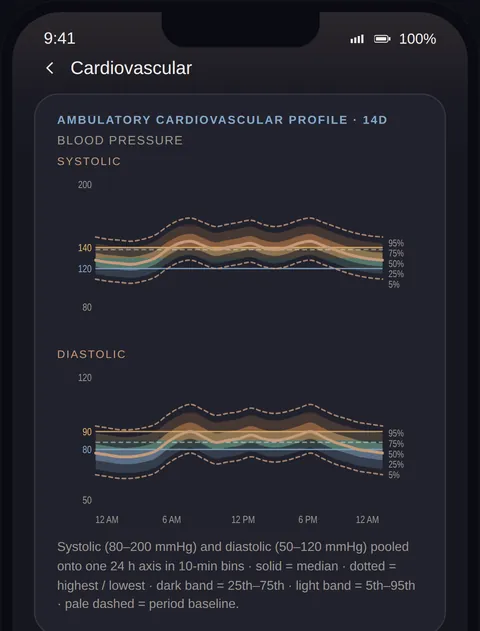
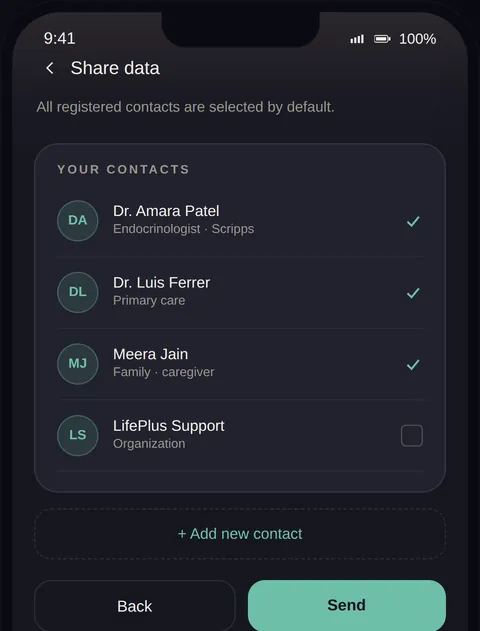
Glucose appears as patterns, ranges and medians — never as point readings. Blood pressure appears as readings. Patients can share a date range with you, or bring a PDF log to the appointment.
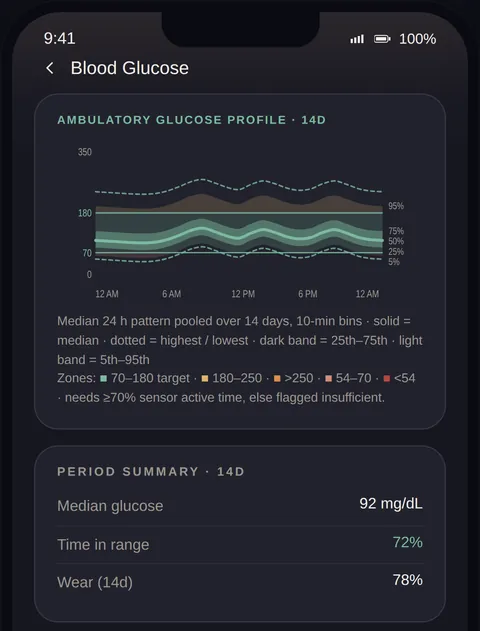
Post-prandial excursions
Which meals move glucose, and for how long.
What you seeSize and duration of post-meal excursions, and how quickly glucose returns toward baseline.
Between visitsDietary conversations based on the patient’s own days, not recall.
Non-nutritive elevation
Rises with no meal behind them.
What you seeGlucose elevation with no logged food; the app treats stress as one possible driver.
Between visitsSeparates dietary patterns from everything else.
Nocturnal blood pressure
Night-time pressure, and whether it dips.
What you seeCuffless readings through sleep, within a 24-hour ambulatory profile.
Between visitsNight-time pressure is hard to capture outside an ambulatory study. Here it arrives with the patient.
Metabolic recovery
Back to baseline by morning?
What you seeA daily score for the overnight return to glucose baseline.
Between visitsLinks evening habits to the next morning’s starting point.
Cardio-metabolic balance
Does pressure ride along with glucose?
What you seeWhether blood pressure rises during glucose excursions — same sensor, same moment.
Between visitsBoth signals on one timeline.
Our newest and least-studied score: a pattern, with no claim of cause and effect.
HRV · respiration · SpO₂
The rest of the picture.
What you seeHeart rate, rhythm, heart-rate variability, respiration rate and oxygen saturation, plus glycemic-variability trends.
Between visitsContext for sleep, recovery and stress.
Coaching is behavioural by design — a walk after meals, slow breathing, an earlier dinner — and never gives medication advice. For patients on GLP‑1 therapy it focuses on hydration, GI tolerability and fueling.
Accuracy at a glance
Tested against four references.
A continuous glucose monitor, a fingerstick meter, a validated cuff and an intra-arterial line. The headline figure from each study is below; populations, sites and methods are on the evidence page.
vs reference CGM
prospective, longitudinal
8.5%
MARD · glucose
83.4% of readings within ±15% of reference; 1.5% more than 40% away.
N = 66 · 10,905 paired readings
Bailey et al., ATTD 2023
vs fingerstick meter
hospital setting
10.8%
MARD · glucose
A diverse population across 12 countries, in a study designed to test performance across skin tones.
N = 248 · 1,713 readings
Bailey et al., ADA 2025
vs validated cuff
outpatient clinics
−0.02 / 0.03
Mean bias, mmHg · sys / dia
SD 12.5 systolic, 8.4 diastolic. Adults aged 18–85.
N = 293 · 1,029 readings
Almahmeed et al., ESH 2023 · J Hypertension 41(S3), E111–112
vs intra-arterial line
Mayo Clinic
0.96 / 0.95
Correlation R · sys / dia
During heart-rhythm procedures, including patients in AF, SVT and VT. Correlation degrades above 140/90 mmHg.
N = 87 (60 training / 27 validation)
Sosin et al., Mayo Clinic · AHA 2025, scientific poster
Three of the four were published as journal-supplement abstracts and one as a scientific poster. We are pursuing independent validation and will publish it.
How to read these figures
MARD (mean absolute relative difference) is the average percentage gap between LifeLeaf and the reference — lower is closer. Mean bias is the average signed difference in mmHg, and the SD is the spread around it. R is the correlation coefficient against the arterial reading.
Read together: how close the estimates sit, and how consistently they stay there.
How it measures
One sensor, three stages.
Reflectance photoplethysmography at several wavelengths, cleaned on the device, and interpreted by models trained on reference vitals collected with informed consent in clinical studies.
Sensor.Multi-wavelength LEDs and a photodiode read light reflected from the tissue. Motion sensors and a skin-contact check tell the pipeline when to trust it.
Signal.Noise is filtered, quality is checked, and the signal is adjusted for demographic features and skin tone before any model sees it.
Model.Each estimate uses the optical signal plus the profile set at account setup. No calibration required, and no fingersticks to enter.
Glucose: near-infrared
LifeLeaf reads glucose with short-wave near-infrared absorption spectroscopy at several wavelengths: more glucose in the tissue, more of that light absorbed. A model trained on reference glucose data turns the absorption signal into an estimate, which the app presents as patterns, ranges and medians — including an AGP-style profile and time in range — rather than point readings.
Blood pressure: RWTT
Each wavelength sees the pulse wave arrive at a slightly different time. That timing shift (Δt) tracks arterial stiffness and pressure; reflected-wave transit-time analysis turns it into systolic and diastolic estimates without a cuff.
When the signal is thin
When signal quality is low, the app shows a shorter band and a plain note instead of a number. A gap is a gap, not a guess.
Ten years of work · 11 granted patents, 5 pending, 4 in progress. The full science →
Scope
What it is for, precisely.
Knowing where a tool performs well is what makes it useful.
Intended use
A general wellness device under FDA general-wellness guidance. It is not FDA-cleared; we are pursuing regulatory clearances in parallel.
Glucose as patterns
Trends, ranges, medians and time in range — never point-in-time mg/dL values. It works alongside your usual testing, not instead of it.
Blood-pressure range
In the arterial-line study, correlation degrades above 140/90 mmHg. At higher pressures, read the LifeLeaf trend next to a cuff.
Signal confidence
When the signal is thin, the app says so — a shorter band and a plain note in place of an estimate.
Newest score
Cardio-metabolic balance is the least-studied thing LifeLeaf shows. It is a pattern, with no claim of cause and effect.
Across skin tones
Skin tone is part of the signal pipeline, and the fingerstick study enrolled 248 people in 12 countries specifically to test it.
Questions clinicians ask
Is LifeLeaf FDA-cleared?
Does it show glucose values?
How does it compare with a CGM?
Does it need calibration?
Can my patients share their data with me?
How does it perform across skin tones?
Investigators and advisors
The people behind the data.
Investigators at Mayo Clinic, Cleveland Clinic Abu Dhabi and AMCR Institute, working with LifePlus’s clinical, science and regulatory leads.
The results presented at ADA this year show that LifeLeaf has the potential to provide accurate data, without invasiveness or complexity. This kind of non-invasive monitoring is uniquely poised to improve patient adherence and enable earlier detection — two critical factors in managing chronic conditions.

LifeLeaf delivers clinically validated performance without the usual barriers of needles, cuffs, or cost. By making blood pressure and glucose monitoring effortless and non-invasive, it drives better patient adherence…
 Timothy Bailey, MD, FACE, CPIEndocrinology · Founder, AMCR InstituteLead author · glucose studiesSam Asirvatham, MD, FACCProfessor of Medicine, Cardiovascular Medicine, Mayo ClinicInvestigator · arterial-line study
 Wael Al Mahmeed, MDCardiology · Heart & Vascular Institute, Cleveland Clinic Abu DhabiLead author · cuff study
 Jerome S. Fischer, MDEndocrinologyCo-author · glucose studies
LifePlus clinical, science and regulatory
 Indranil Sen-Gupta, MDChief Medical Officer · Clinical faculty, Neurology, UC IrvineCo-author · validation studies
 Nilanjan Banerjee, PhDChief Scientific Officer · Professor of Computer Science, University of MarylandCo-author · validation studies
 Alberto Gutierrez, PhDChief Regulatory Advisor · formerly Director, Office of In Vitro Diagnostics and Radiological Health, CDRH, FDARegulatory
Where the studies ran
- Mayo Clinic
- Cleveland Clinic Abu Dhabi
- AMCR Institute
- PGI Chandigarh
- Hospital Seberang Jaya, Malaysia
- Saudi German Hospital, Dubai
- Helios Heart Clinic, Germany
70,000+ paired readings across seven clinical sites.
Work with us
Let’s talk about your patients.
Research, a patient pilot, an advisory role, or information to share with patients. Tell us which, and our clinical team will follow up.
- Research. Study design and data collaboration.
- Pilots. LifeLeaf with a defined group of your patients.
- Advisory. Shape the clinical roadmap as the product moves toward clearance.