The science
How it sees, without breaking the skin.
One wrist-worn sensor reads blood sugar and blood pressure using light, not a needle or a cuff — and an algorithm built to pick up a real signal from an ordinary day’s noise.
How it senses: optical, light-based sensing at the wrist, interpreted by AI trained against clinical reference devices — and taught to work in the real world, not just the lab.
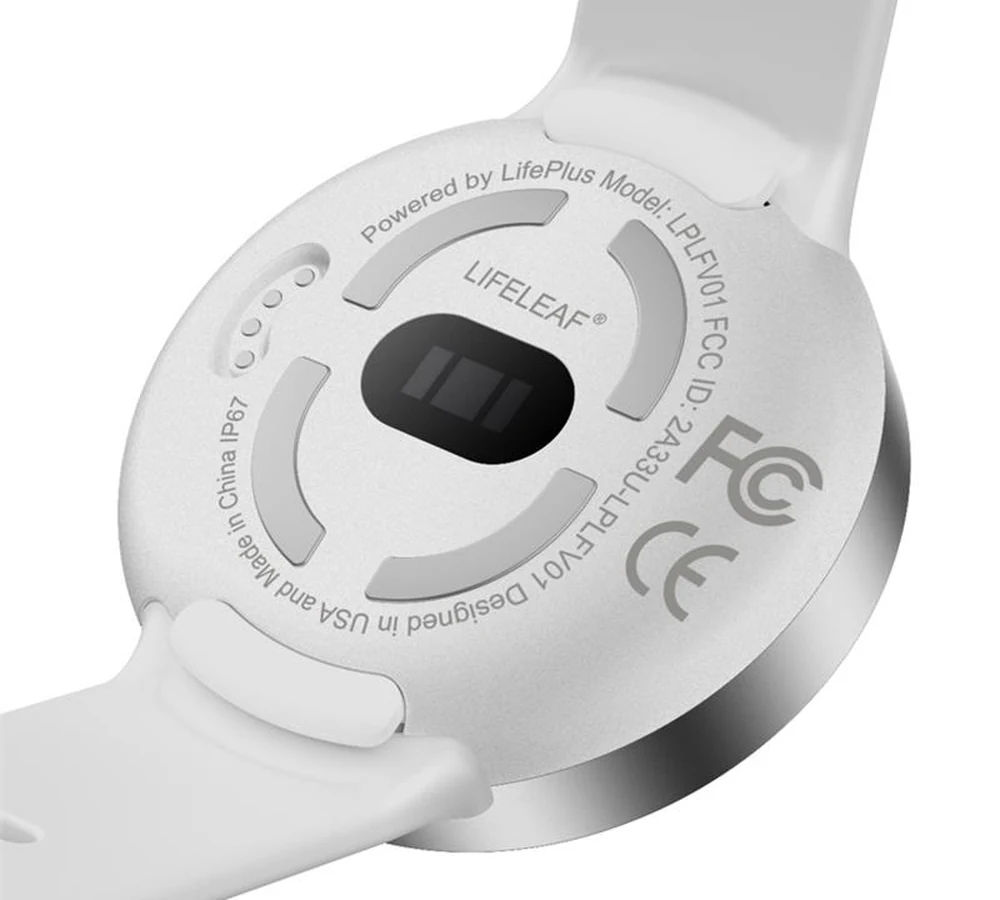
The sensor
Light in, signal out — no needle, no cuff.
An LED on the underside of the watch shines light into the wrist. Blood absorbs and scatters that light differently as it pulses through the vessels just under the skin, so the fraction that bounces back to a photodetector changes slightly with every heartbeat, influenced by several physiological dynamics.
That returning light is the raw material for every score LifeLeaf produces — the same optical principle, photoplethysmography (PPG), used in a hospital pulse oximeter, applied here to read more than oxygen and heart rate.
How the light gets read
Reflectance PPG. Light from the LED travels down through the skin’s layers to the blood vessels beneath, scatters, and part of it comes back up to the photodetector. Arteries swell slightly with every heartbeat, so the amount of light that returns rises and falls with each pulse — the same principle used in a hospital pulse oximeter, adapted to work through the wrist.
No needle
Blood sugar, read from light reflected under the skin.
No patch
Nothing to apply, wear separately, or replace every two weeks.
No cuff
Blood pressure without squeezing an artery.
One wrist
Glucose, blood pressure, heart rate, rhythm and HRV - from the same sensor, all day.
The hard part
Separating a real signal from an ordinary day.
Semiconductors, signal processing, AI, and physiology are an unusual combination of disciplines — and it’s why LifePlus spent ten years on exactly this problem: pulling a real physiological signal out of the noise every wrist-worn sensor has to fight through, on a device small enough to forget you’re wearing.
Movement, daylight, sweat, and temperature all show up in the same raw optical signal as the dynamic features of blood sugar, blood pressure and other physiological signals do. Proprietary signal processing is what separates the two before a reading is ever produced — the five steps shown here, on every wavelength, continuously.
From raw light to a clean signal
Raw signal
Multiple wavelengths of light, captured continuously from the wrist.
Filter out the noise
Motion, ambient light, sweat and temperature get subtracted first.
Check signal quality
A weak or unreliable stretch gets flagged before it’s ever used.
Calibrate for demographic features
The model adjusts for what the app learned about you at setup.
Hand off to the model
A clean signal reaches the AI layer that turns light into a number.
What gets measured is the biology underneath — not the environment around it.
The algorithm
Trained on real life, not just the lab.
Underneath the sensor is a suite of machine-learning models built specifically to read these signals. Algorithms trained only on clean, lab-generated data tend to struggle the moment someone walks, sweats, or steps into the sun — so LifeLeaf’s models are trained on large volumes of real-world data instead, collected with the ordinary noise of daily conditions built in from the start.
Optical sensing at the wrist doesn’t perform equally on all skin tones. The app assesses skin tone at setup, and the model accounts for it — a design choice built into the study that enrolled 248 people across 12 countries specifically to test it. See the clinical evidence.
Lab data vs. real-world data
Lab data
Controlled, quiet, a narrow range of conditions
Real-world data
Motion, light, temperature, skin tone — the conditions LifeLeaf actually runs in
Reliability is designed around daily life, not a lab bench.
Real-world training
Trained on data collected during ordinary days, not just in a lab.
Advanced signal processing
Motion, ambient light, sweat and skin tone are accounted for
Multi-modal AI
Several signals and derived features combine into a single reading, not one raw number.
Built to call out what it doesn’t know
The most useful thing a wearable can do is admit when it isn’t sure.
When the signal is thin, LifeLeaf shows a plain note instead of a confident-looking number it doesn’t trust. That honesty is designed into the algorithm, not bolted on afterward.
Signal strength, at a glance
A shorter bar, and a plain note, instead of a confident-looking number we don’t trust. A gap is a gap, not a guess.
The team and the IP
Built by people who’ve spent decades on exactly this problem.
LifePlus is built by a world-class team spanning the domains of semiconductors, signal processing, AI, and physiology.
This deep science team is complemented by a few of the world’s leading clinical researchers in the domains of cardiology, endocrinology, neurophysiology and pulmonology, working to decode some of the most difficult physiological measurement challenges that have remained open for many decades.
LifePlus holds 11 granted patents, with 5 pending and 4 in progress — covering how the wrist signal is captured, cleaned, and read.
Where this stands
Today LifeLeaf is a general wellness device. We’re pursuing regulatory clearances in parallel — we’ll tell you plainly what changes when they arrive.
Independent clinicians advise LifePlus and check the work — see the advisory board.
For the accuracy figures, study populations, and clinical sites behind those numbers, see the clinical evidence.
How do I get it
Join the waitlist.
We’ll email you launch updates and the moment Kickstarter opens at the end of October. Deep‑discount packages are limited and go first-come, first-served.
Free to join — or reserve now for $2 to lock founder pricing.