The scores
Three scores every morning. An Age that moves over months.
Each answers a different question. None of them is a test.
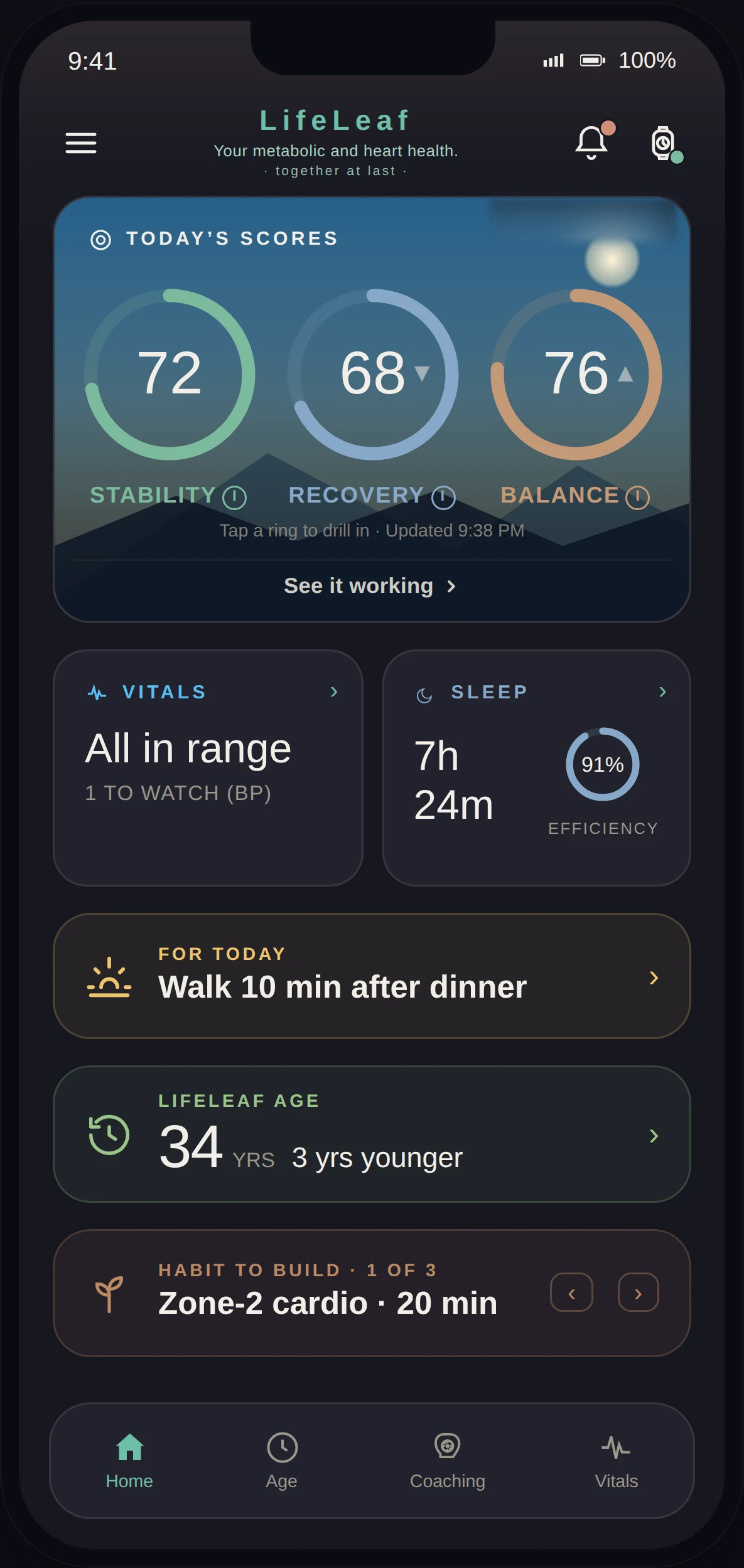
They are not four grades for the same thing. Stability, Recovery and Balance tell you how today went.
LifeLeaf Age tells you where the months are heading.
The score
One number, so the picture fits in a glance.
What moved it
The pattern underneath, by name.
How complete the data was
Whether LifeLeaf saw enough.
One thing to do
A low-risk step to try next.
| Score | The question | Open it when |
|---|---|---|
| Stability | How steady was my blood sugar today? | Open it when you want to know whether today was really steadier. |
| Recovery | How fast did my body settle back down? | Open it when a day went sideways. |
| Balance | Are my heart and metabolism moving together in a good way? | Open it for the whole-body view. |
| LifeLeaf Age | How does my body compare with what is typical for my age? | Open it to follow the months. |
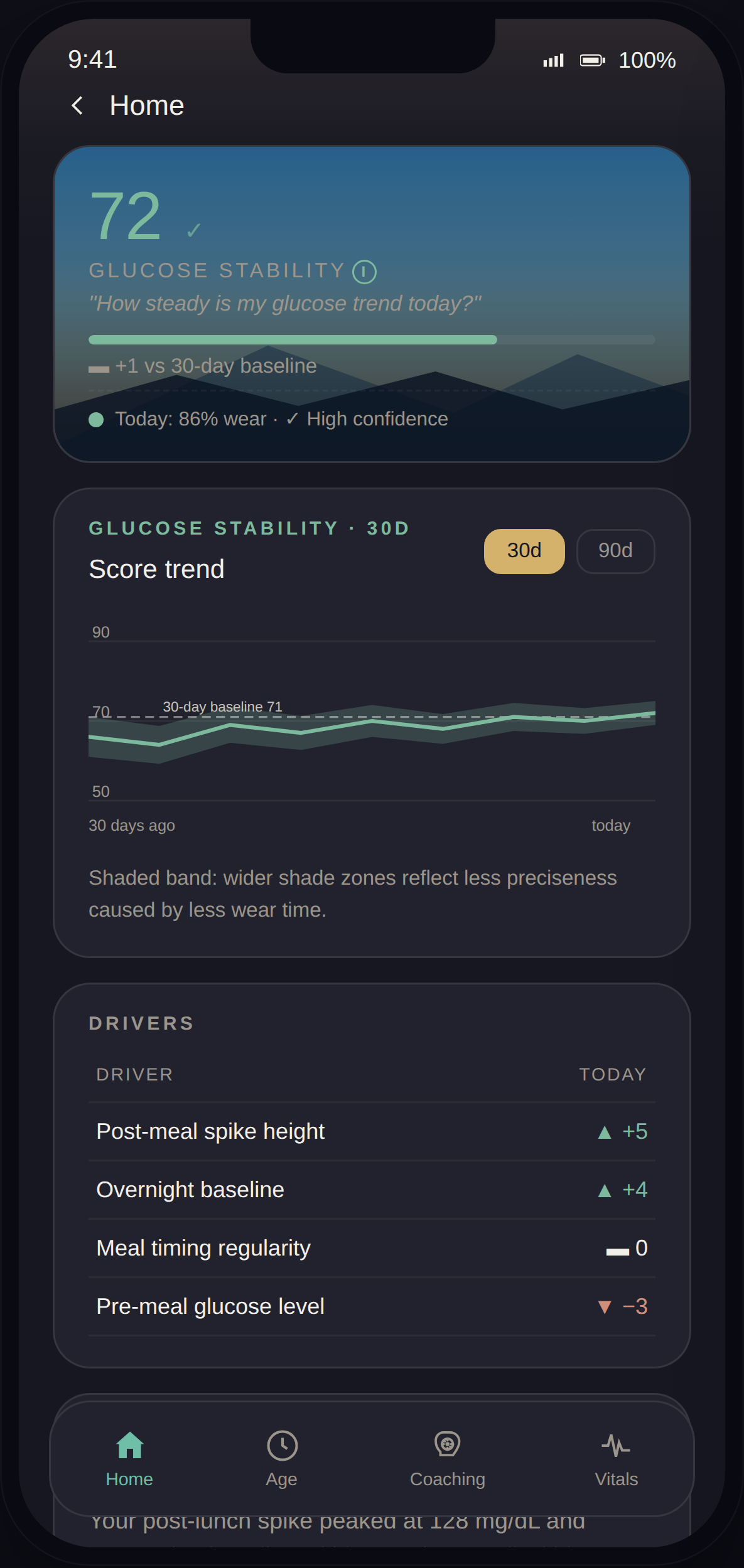
STABILITY · Glucose Stability
How steady was my blood sugar today?
One blood sugar reading is a photo. Stability is the whole video. Two people can have the same number at 3 p.m. after very different afternoons.
Two afternoons with Jordan, 44.
| Day A | Day B | |
|---|---|---|
| At 3 p.m. | looks ordinary | looks ordinary |
| The hours before | small movement | a bigger rise, a slower return |
| What Stability adds | a steadier day | a less steady day behind an ordinary snapshot |
| Next step | keep it as a reference | repeat the lunch, add a short walk after it |
Not a blood glucose result, a diabetes test, or a number to compare with anyone else.
RECOVERY · Metabolic Recovery
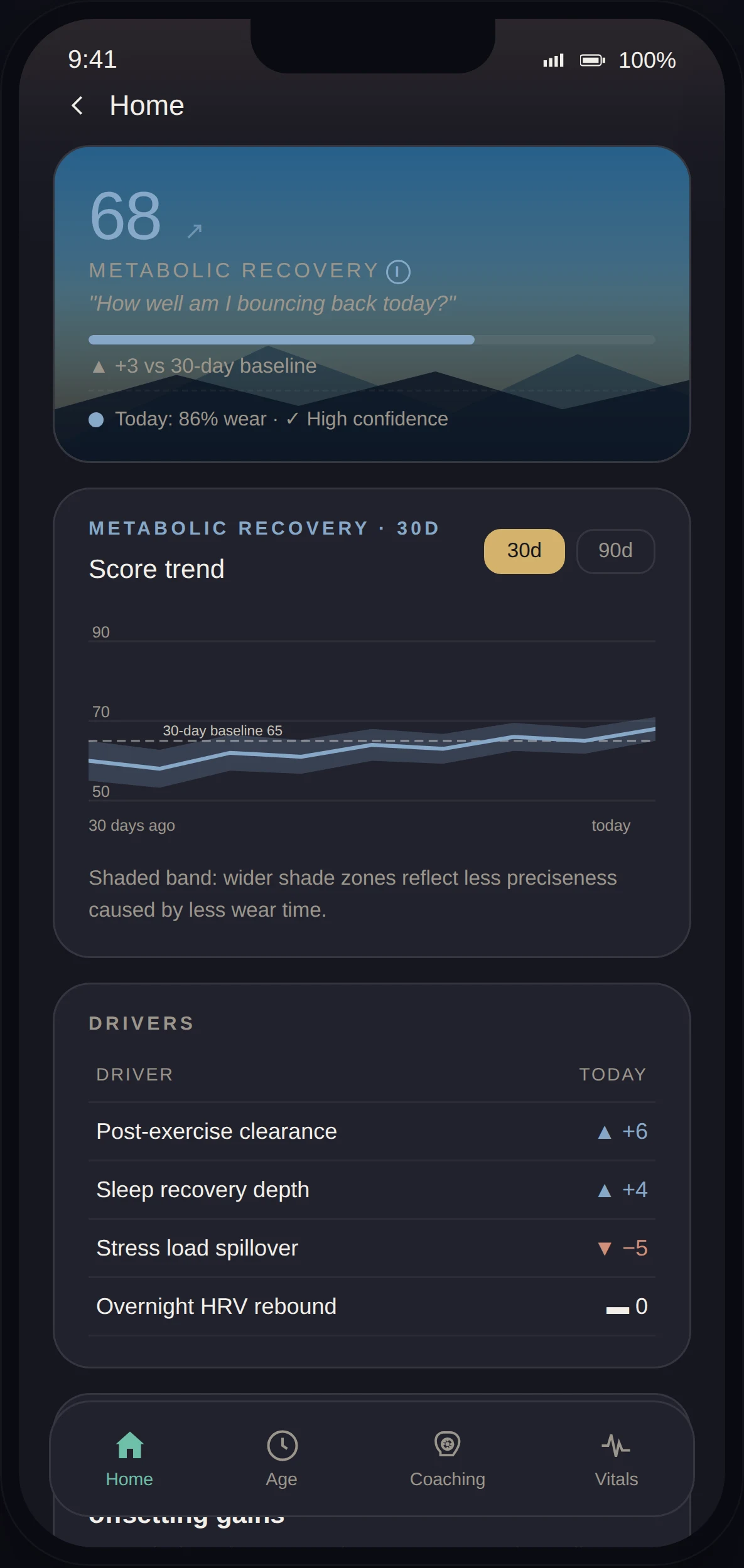
How fast did my body settle back down?
Two people run up the same stairs. One is breathing normally in a minute; the other takes ten. The peak was the same. Recovery watches the second half.
Two similar days for Elena, 34.
| Day A | Day B | |
|---|---|---|
| Daily average | the same on both days | |
| After a meal | a bigger rise that settles fairly quickly | a smaller rise that lingers into the evening |
| Overnight | back to her usual pattern | less settled, shorter sleep |
| Next step | keep watching similar days | compare meal timing and gentle movement |
Not a lab test of metabolic flexibility or insulin sensitivity.
BALANCE · Cardio-Metabolic Balance
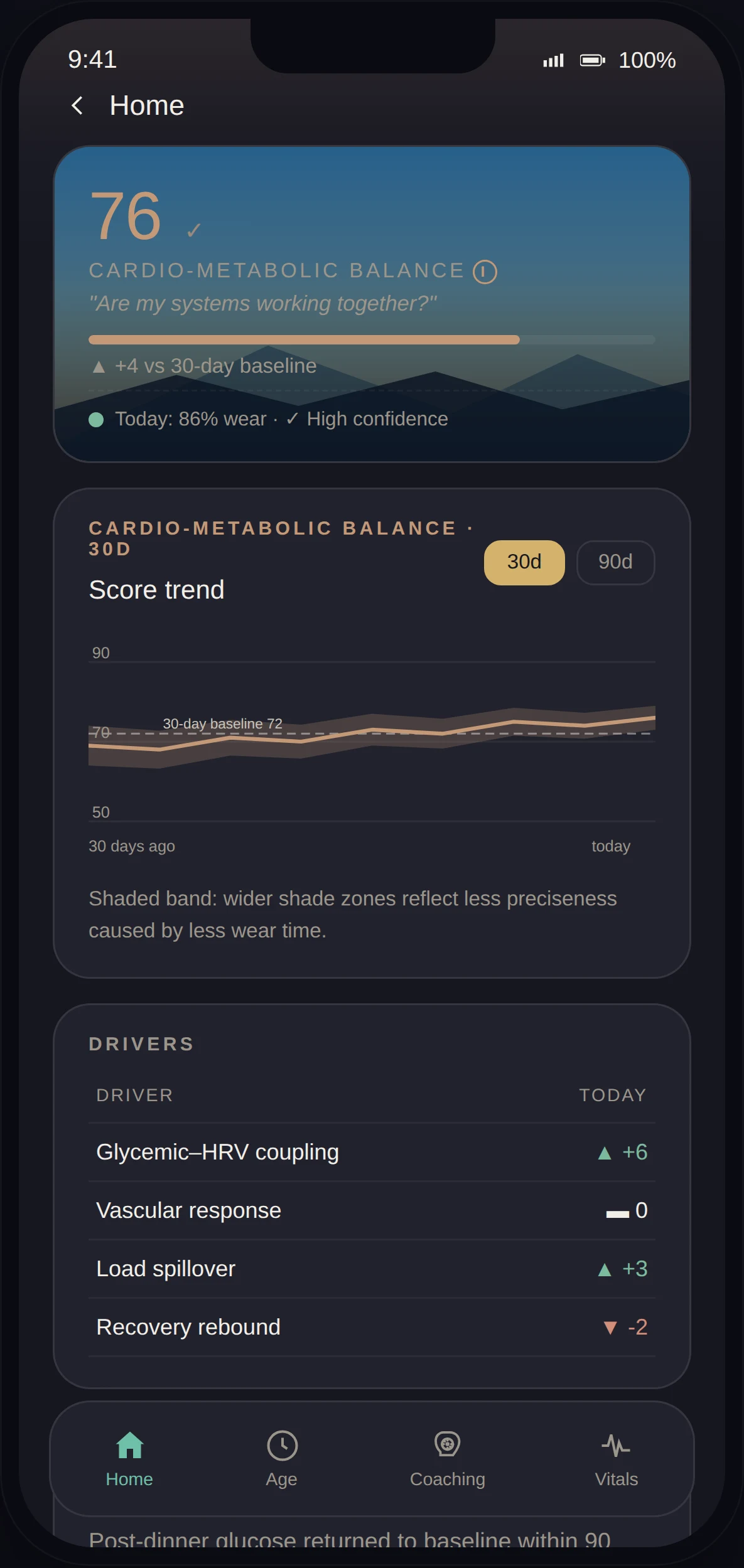
Are my heart and metabolism moving together in a good way?
A weather report gives you the temperature, then a "feels like" number — because 38 degrees in still air and in a hard wind are not the same day. Balance does that for blood sugar, pressure, pulse, breathing and sleep.
An ordinary Tuesday with Aisha, 48.
| Morning | short sleep, rushed start → recovery and pressure context | |
| Midday | breakfast on the go, long meeting → blood sugar, pressure and pulse on one timeline | |
| Afternoon | hours of sitting → whether blood sugar and pressure moved together | |
| Evening | a walk after dinner → whether both settle together | |
Not a heart-risk score, a diagnosis, or proof that one system caused the other to move. It is also the newest and least-studied thing LifeLeaf does.
LifeLeaf Age
The score that moves in months, not every morning.
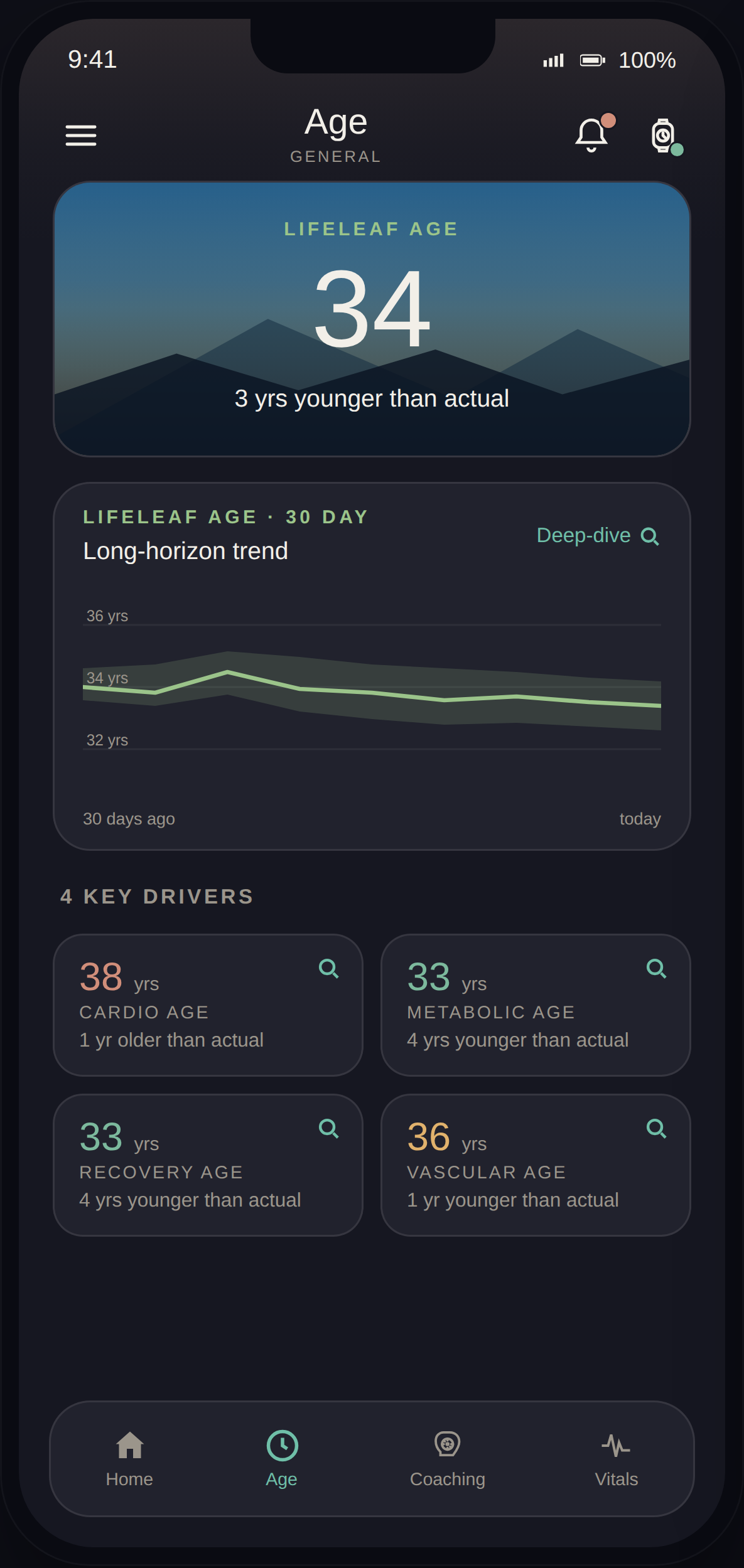
Your birthday is a fact. It is also a blunt one. LifeLeaf Age turns four patterns — heart, metabolism, recovery and blood vessels — into one number in years, and keeps four driver ages underneath so you can see which one is setting it.
It is a wellness estimate, not a prediction of anything. Read the trend over months. Do not chase it daily.
How a score is built
Sense it → compare to your target → count only confident data → score it 0–100.
The exact weighting stays proprietary. The inputs, the direction, the data we needed, the contributors and the limits are all published — enough to understand the score without publishing a formula anyone could copy.
What happens when LifeLeaf didn’t see enough?
A wrist device can only read what it actually saw.
If the device was off your wrist, LifeLeaf does not invent the missing part — and it never treats missing data as bad news. You see how long you wore it and how complete the data was, so you can weigh the result yourself. A guess should never look like a finding.
The app shows wear time and data completeness, not a confidence score.
Reading the scores
Read the trend, not the day.
What you're seeing
| You see | Likely means | Do this |
|---|---|---|
| One low day | ordinary variation or a thin data day | note it and carry on |
| The same direction across similar days | a pattern worth naming | open what moved it |
| A pattern that repeats for weeks | worth acting on | try one low-risk change |
| A big jump on a patchy week | almost certainly the data | wear it for a week and look again |
Enough data?
| You see | Means | So |
|---|---|---|
| Enough usable data | you wore it consistently | read the result with its baseline |
| Some gaps | shorter wear or a weak signal | that part counts for less |
| A key window missing | too little data | collect a cleaner week first |
The app shows wear time and data completeness, not a confidence score.
None of these is a test. They are patterns from your own body, watched over time.
How do I get it
Join the waitlist.
We’ll email you launch updates and the moment Kickstarter opens at the end of October. Deep‑discount packages are limited and go first-come, first-served.
Free to join — or reserve now for $2 to lock founder pricing.