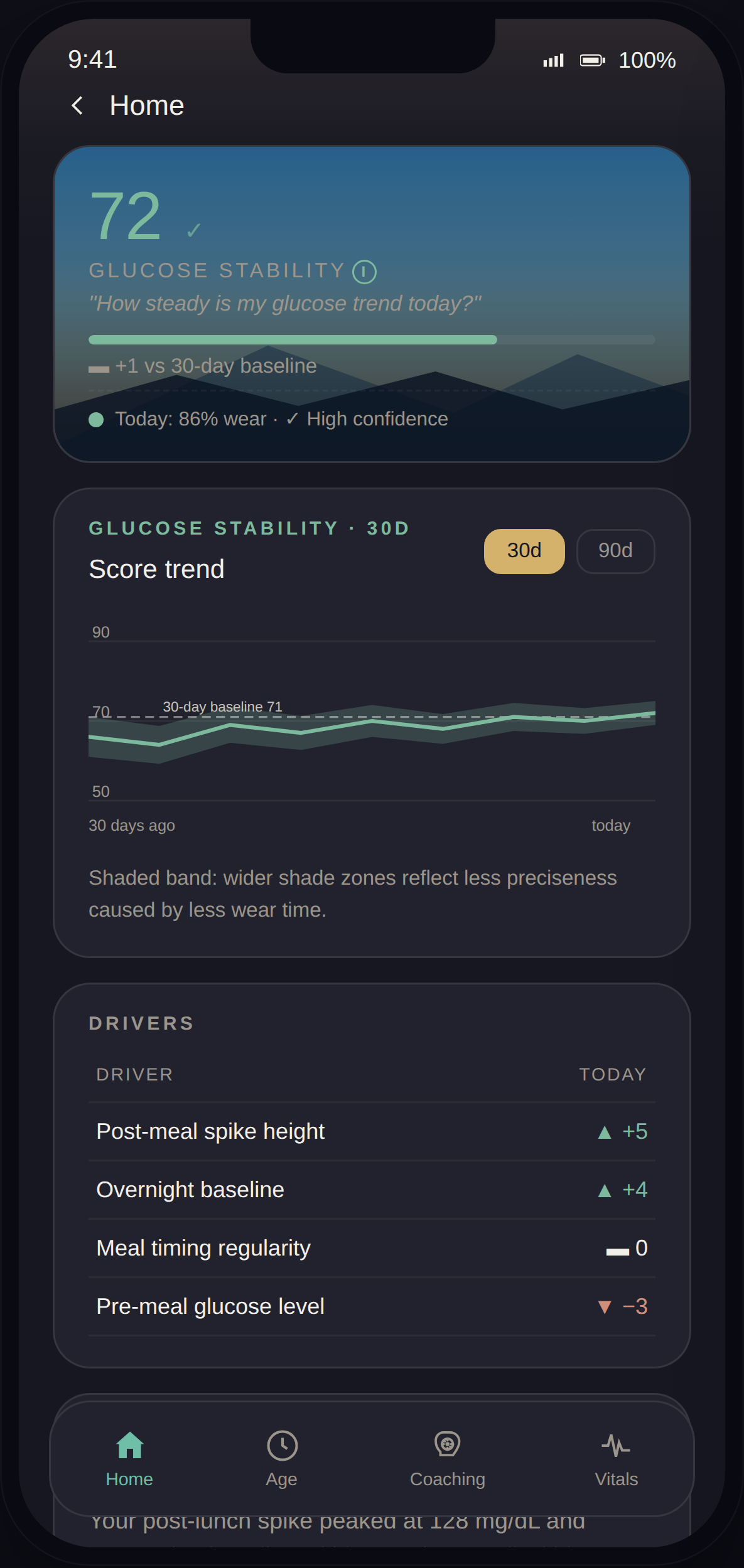
Two people can post the exact same glucose reading at three in the afternoon after completely different days. One has been level since breakfast. The other spiked hard after lunch and only just came back down. The reading is identical. The variability is not.
Glucose variability describes the size and frequency of those swings — how far a trend rises and falls around its own average, not the average itself. A steady line and a jagged one can average out to the same number and tell very different stories about how the day actually went.
Why the average alone can mislead
- A day of small, frequent swings and a day of one large spike can land on the same daily average.
- Large swings are generally considered less desirable than a steadier trend at a similar average, which is part of why time-in-range and variability are usually read together rather than either alone.
- Variability is also where meal composition, timing, and activity tend to show up first — often before an average, or a scale, moves at all.
LifeLeaf's version of this idea
LifeLeaf's Stability score is built around this exact distinction. Its own framing is direct about it: one glucose reading is a photo; Stability is the whole video. The score tracks drivers like how high a post-meal spike runs and how quickly it settles, and how steady the overnight baseline holds — the shape of the trend, not just its average.
It is read as a trend over days, not a single verdict, and like every LifeLeaf score it only counts data it has enough wear time to be confident in. It is a wellness score, not a diagnostic one, and it doesn't identify or manage a condition on its own.
Reading it alongside time in range
Variability and time in range answer related but different questions, which is why LifeLeaf shows both rather than folding one into the other. Time in range says how much of the day landed inside a target band. Variability says how bumpy the road was getting there — two trends can spend the same share of a day inside range while one arrived there smoothly and the other zig-zagged in and out along the way.
Not a medical device · does not diagnose or treat