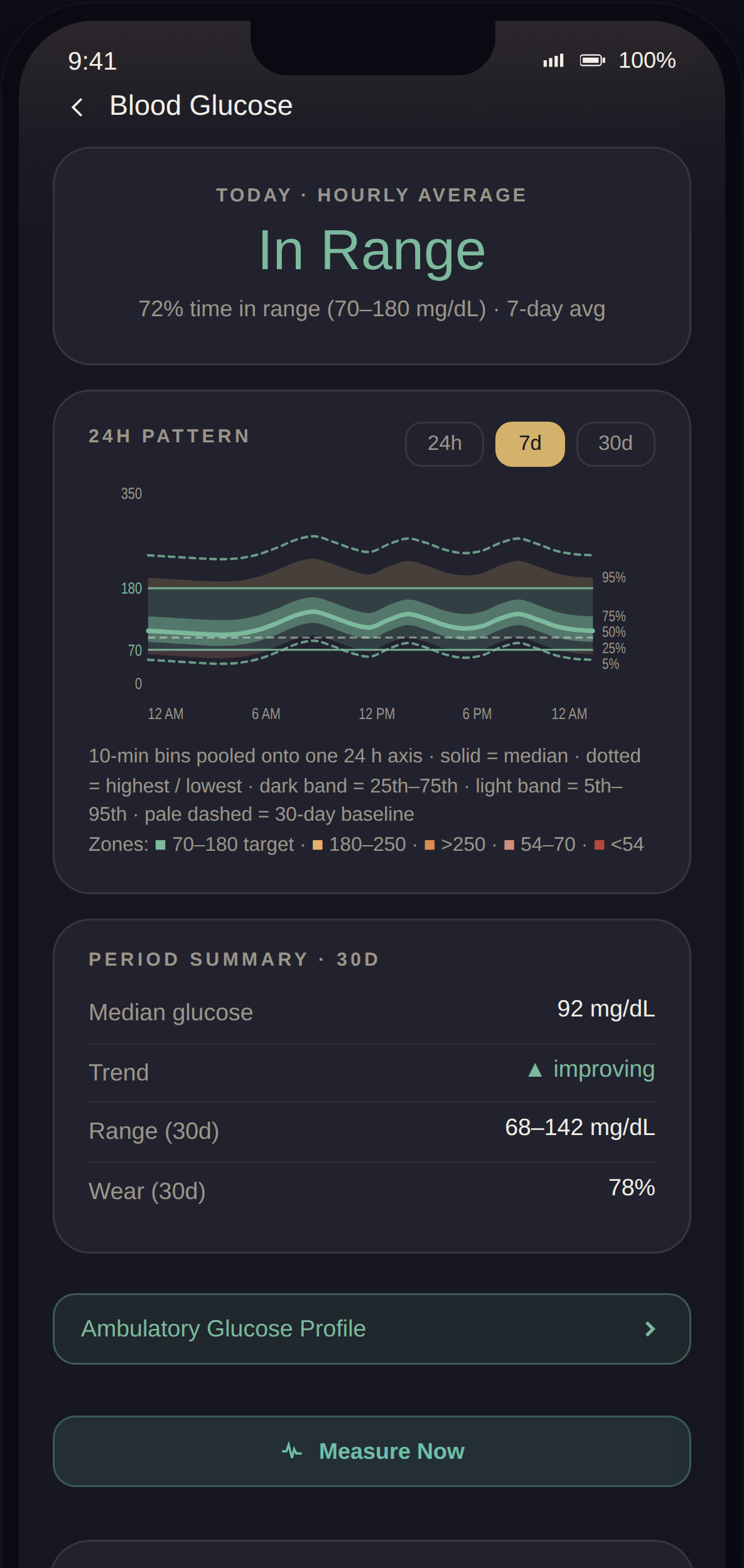
A single glucose reading tells you where you are right now. Time in range tells you how the day, or the week, actually went. It is the percentage of a monitoring period a continuous glucose signal spends inside a target band, instead of one number pulled from one instant.
Where the range comes from
The 70-180 mg/dL band is not a LifeLeaf invention. It is the general target range set out by an international consensus of continuous glucose monitoring researchers and clinicians, published in Diabetes Care in 2019, and it is the same band most consumer and clinical glucose tools use as their default. LifeLeaf marks it the same way: a band with 70 and 180 labeled, and a percentage of the last 7 days spent inside it.
Why it beats a single number
- Two people can log the identical reading at 3pm after completely different afternoons — one steady all day, one that spiked after lunch and took two hours to settle.
- A single reading cannot tell those two afternoons apart. A week of time-in-range data can.
- It rewards consistency over the day, not just the value at the moment you happened to look.
That is also why time in range tends to move before other numbers do. On the LifeLeaf site, the one worked example is the weight-management chart: over 12 weeks on the program, time in range climbs from 54% to 83% while indexed body weight stays roughly flat for the first six weeks before it starts to decline. The range moves first; the scale catches up later.
What it is not
Time in range is a wellness trend, not a diagnostic reading, and LifeLeaf's own display never shows a single point-in-time glucose value — only the range position and the percentage. If a signal isn't confident enough to report, LifeLeaf says so rather than showing a number anyway.
Not a medical device · does not diagnose or treat